You’ve probably heard of India’s exotic landscapes, diverse cultures, and delectable cuisine. But have you ever considered the depth of its history?
From the ancient Indus Valley civilization, Buddhism, and Jainism’s ethical teachings, to the Maurya Dynasty’s governance legacy and the Gupta Empire’s golden age, India’s past is rich and varied. Not forgetting the Islamic Sultanates’ architectural influence, or the resilience shown in India’s democratic evolution.
There’s so much more to explore, so why not set out on this historical journey with us?
The Indus Valley Civilization’s Influence
One can’t ignore the profound influence of the Indus Valley Civilization, an ancient society that greatly shaped the cultural, technological, and urban landscape of what’s now modern India.
You’d be amazed to know that Harappan Architecture, with its meticulously planned cities, drainage systems, and uniform brick sizes, lays the foundation for today’s urban planning.
Their agricultural innovations, too, were ahead of their time. They introduced irrigation systems and crop rotation, paving the way for a stable food supply.
The Indus Valley folks mightn’t be around anymore, but their influence is.
You’re part of a history that’s rich, complex, and worth exploring. So, explore it, understand it, and you’ll start to appreciate the roots of India’s vibrant culture and technological advancements.
The Advent of Buddhism and Jainism
As you trace the lineage of India’s rich history, you’ll find that the emergence of Buddhism and Jainism marked a substantial shift in the religious and philosophical landscape of the country. Born in the 6th century BCE, these faiths introduced new perspectives.
The Buddhist philosophy influence was profound, emphasizing on non-violence, compassion, and the middle path of moderation. It appealed to the masses and led to a social transformation.
Meanwhile, Jainism ethical practices, with its strict adherence to truth, non-violence, and asceticism, set a high moral standard. Its reverence for all life forms, irrespective of size or species, is truly remarkable.
Together, Buddhism and Jainism significantly shaped India’s cultural, ethical, and moral fabric, leaving a lasting legacy.
Maurya Dynasty’s Impact
Diving deeper into India’s historical timeline, you’ll encounter the Maurya Dynasty, a powerful empire that left an indelible imprint on the nation’s political, cultural, and administrative spheres.
This dynasty, renowned for its Mauryan Artistry, marked an era of an intricate blend of art and religion, resulting in unique sculptures, architectures, and literary pieces.
Ashoka, the most famous Mauryan ruler, is remembered for Ashoka’s Edicts, stone inscriptions laying down ethical principles of governance. These edicts, scattered across India, reflect his transformation from a ruthless conqueror to a benevolent ruler advocating peace, compassion, and tolerance.
The Maurya Dynasty’s structure, governance, and cultural contributions profoundly influenced future Indian empires, shaping the nation’s identity and legacy.
Gupta Empire: The Golden Age
Moving forward on the historical timeline, you’ll come across the Gupta Empire, often referred to as the Golden Age of India, where the country experienced significant advancements in arts, science, culture, and philosophical thought. This era, stretching from 320 to 550 CE, was marked by remarkable Gupta architecture, with intricate temples and sculptures exhibiting the aesthetic brilliance of that time.
The Empire’s scientific advancements were equally impressive. Concepts of zero and the decimal system were developed, enhancing mathematical understanding. In medicine, they performed complex surgeries, setting a foundation for modern medical practices. Astronomy flourished, leading to accurate predictions of lunar and solar eclipses. Their contributions are a reflection of India’s rich historical and cultural heritage, making the Gupta Empire a significant era in India’s timeline.
The Islamic Sultanates Era
After the Gupta Empire’s reign, India entered a new historical period known as the Islamic Sultanates Era. This era, marked by the dominance of Muslim rule, brought about significant changes in India’s cultural landscape. One of the most notable impacts was Sultanate Architecture, a unique blend of Indian and Persian styles. You’ll notice the intricate carvings and domed structures, reflecting Islamic aesthetics.
The period also saw a flourishing of Islamic Literature, with an influx of Persian and Arabic works. Poets and scholars like Amir Khusrow contributed to a rich literary tradition, blending Persian, Arabic, and local dialects. The Sultanates Era, therefore, wonderfully encapsulates the cultural syncretism that has shaped India’s diverse heritage.
The Mughal Dynasty’s Reign
Entering the era of the Mughal Dynasty, you’ll find it’s a period that greatly shaped India, marked by grand architectural accomplishments, an enriched cultural milieu, and considerable political changes.
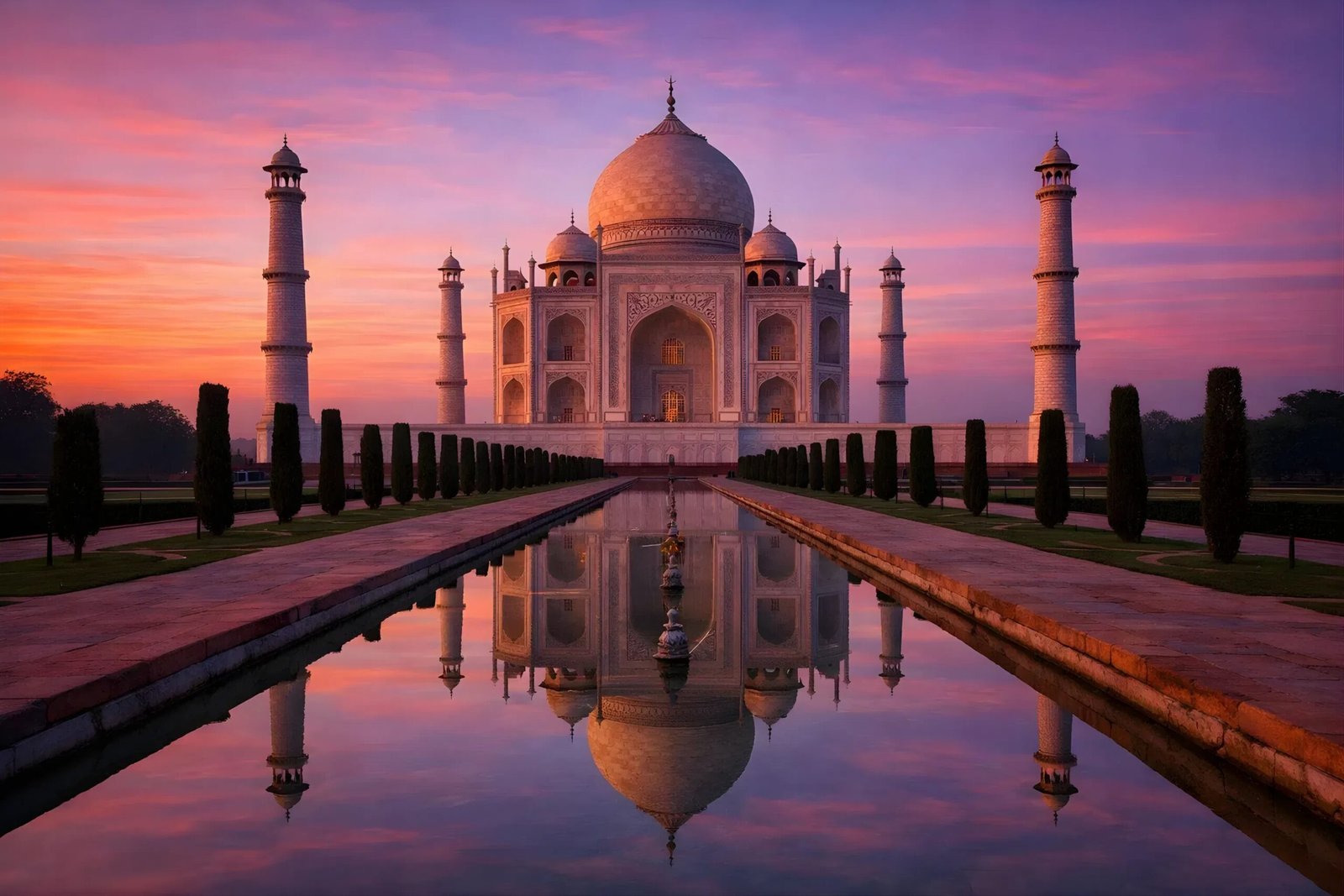
You’ll be awestruck by the Mughal Architecture, with iconic monuments like the Taj Mahal, Humayun’s Tomb, and Fatehpur Sikri, which embody the intricate design and aesthetic finesse of the period. These structures aren’t just beautiful, but they’re also symbolic of the dynasty’s power and wealth.
Alongside this, the Mughal Cuisine too emerged, renowned for its rich flavors and exquisite dishes like Biryani and Kebabs.
This era wasn’t just about power, but it shone through the arts and culture, laying a foundation that makes India the diverse nation it’s today.
The Influence of British Colonization
Switching focus, let’s explore the impact of British colonization, a momentous era that brought about profound changes in India’s economic, political, and social spheres. You’ll notice remnants of British rule in India’s Colonial Architecture, with stately buildings, churches, and railway stations exhibiting Victorian, Gothic, and Art Deco styles. These structures, like Mumbai’s Chhatrapati Shivaji Terminus, serve as constant reminders of a bygone era.
British Education also left a lasting imprint. The English language was introduced, transforming India’s education system and establishing English as a medium of instruction in many schools. This influence remains today, with English being one of India’s official languages. The British era, with all its complexities, played a crucial role in shaping modern India.
The Struggle for Independence
While the British rule had profound impacts on India’s landscape and culture, it’s equally important to understand the fervor of India’s fight for independence that emerged in response to this foreign dominance.
The struggle was marked by a unique approach known as Gandhi’s Philosophy. This involved nonviolent resistance campaigns like civil disobedience and boycotts, which thrust the nation into a turbulent yet transformative era.
The fight culminated in the independence of India in 1947. However, the joy was short-lived as the partition aftermath unfolded, leading to a violent, tragic period of mass migrations and communal riots.
This struggle for independence not only shaped India’s present but continues to influence its future.
The Birth of Modern India
In the aftermath of its hard-fought independence, India began a new chapter, evolving into a modern nation with its own unique blend of ancient traditions and contemporary innovations. The colonial aftermath brought both challenges and opportunities.
It was under Nehru’s leadership that India navigated through this complex phase, endeavoring to retain its cultural essence while embracing the benefits of modernization. Nehru, India’s first Prime Minister, laid the foundation for a democratic, secular, and socially equitable society. He championed the cause of science and technology, education, and infrastructure development, shaping India’s trajectory towards progress.
The Evolution of Indian Democracy
As we continue our journey through India’s history, let’s now turn our attention to the evolution of its democracy, a political system that has been shaped by the country’s rich cultural tapestry and unique historical experiences.
The roots of Democracy’s Evolution in India trace back to the ancient times, yet its true establishment occurred post-independence in 1947. The Post Independence Politics saw the birth of the world’s largest democratic constitution, reflecting a blend of socio-political ideologies.
India’s democracy has evolved over the years, weathering numerous political, social, and economic challenges. It’s a dynamic system, continually adapting to the nation’s diverse needs. Yet, despite its complexities, Indian democracy remains a beacon of hope for nations aiming for democratic governance.
In Closing
So, you’ve journeyed through India’s history, from the ancient Indus Valley Civilization to its modern democratic evolution.
You’ve seen the ethics of Buddhism and Jainism, the governance of the Maurya Dynasty, the cultural bloom of the Gupta Empire, and the architectural marvels of the Islamic Sultanates.
You’ve witnessed the struggle against British colonization and the birth of independent India.
It’s a rich tapestry indeed, showcasing how India’s diverse past shapes its present and influences the world.