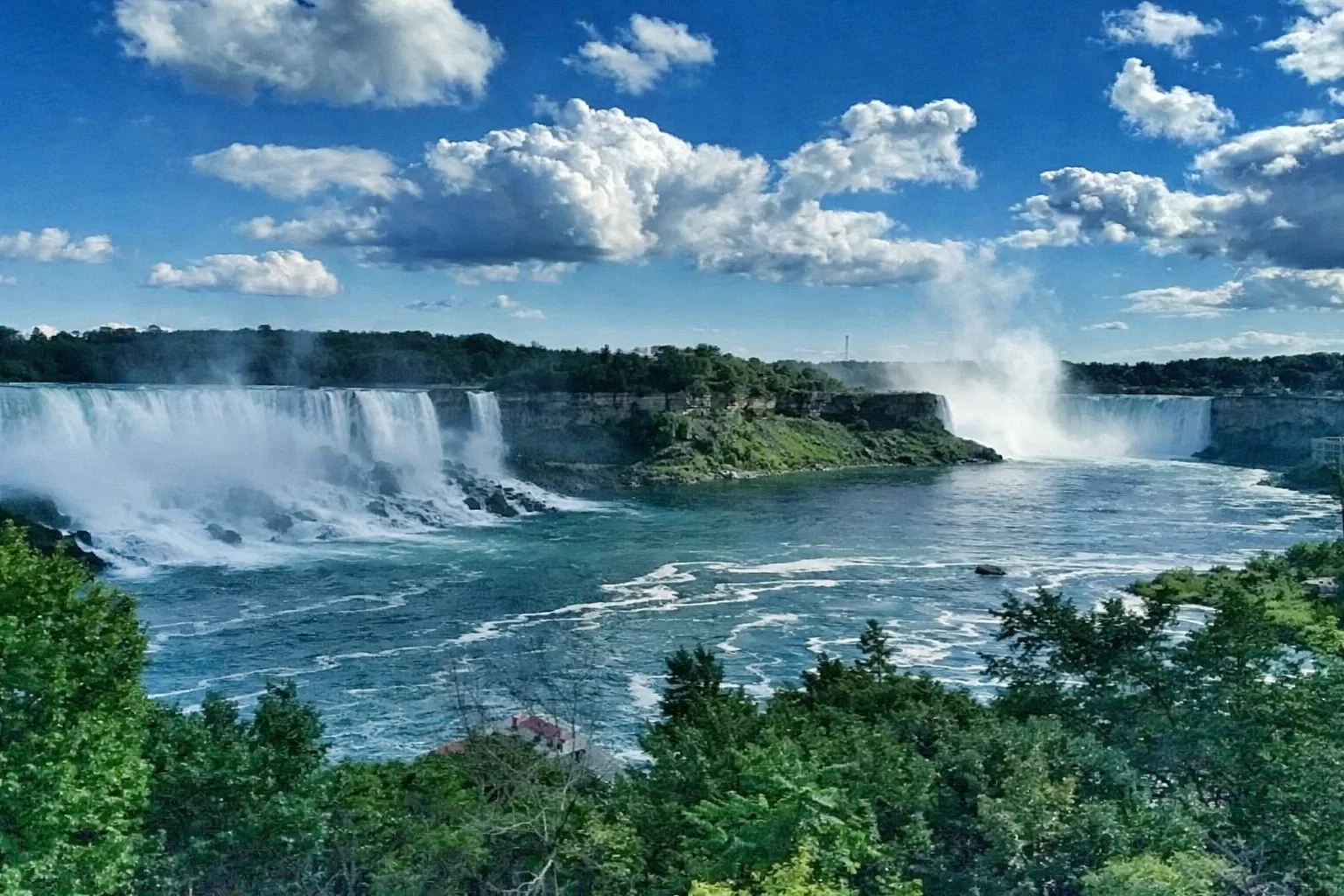
Nothing about Niagara Falls is subtle.
This is a place not of idealised postcard imagery but of uncompromised presence. Here, moving water meets moving air with an urgency that doesn’t entertain quiet admiration — it demands responsive attention.
Set on the border between two countries, the falls are less a single feature and more an assembly of forces shaped by water and gravity over centuries.
Horseshoe Falls curves in a broad, near-perfect arc; the American and Bridal Veil sections punctuate the river’s course with fractured cascades. Together, they mark a boundary not just on a map, but between the conditions of calm river and unfettered descent.
What You See Is Only the Start
Numbers and measurements — height, volume, flow rate — become secondary when you stand close. The scale of the falls is perceptible first through sound and vibration. A rumble that feels physical, an ambient force that simulates an unseen engine. This is not background; it is the experience itself.
Observation platforms on both sides offer distinct engagements. From the Canadian vantage, the broad sweep of Horseshoe Falls feels almost architectural in its regularity, an ordered curve of unstoppable water.
From the American side, layered edges and abrupt drops give the impression of multiple stories falling at once. Two perspectives on the same phenomenon, each precise in what it reveals and what it conceals.
The Environment as Active Participant
Mist here is more than a visual element. It becomes a kind of atmospheric texture: cool at dawn, thick by midday, and glittering when sunlight intersects airborne droplets.
Rainbows form and dissipate on their own rhythms. The air holds a moisture that alters light, alters perception, interferes with conventional ideas of distance and depth.
This is a space in which the environment asserts itself rather than merely complements the scenery.
Routes Beyond the Edge
Stepping away from the immediate brink, the surrounding terrain unfolds with intention.
Trail routes trace the contours of the gorge, each bend offering a different alignment of river and rock layers. The escarpment above the falls hosts cultivated landscapes — orchards and vineyards — that borrow the region’s thermal advantages, turning what is wild into production without erasing the elemental force below.
This juxtaposition of precise human intervention and raw geological process is part of Niagara’s character. It resists singular interpretation, inviting instead multiple forms of participation.
A Place to Reframe Expectations
Niagara does not conform to familiar narratives of travel destinations that prioritise ease of consumption. It is best approached with a readiness to adjust expectations: to accept that an encounter with water might be something felt in the body before it is understood by the mind; that scale is relative, and environmental presence is a quality, not a metric.
For those drawn to landscapes that articulate their own terms, Niagara Falls offers an encounter that is thorough and exacting — a place where the terrain itself suggests that understanding is not delivered, but earned through attention.